

Green Fuse Gallery (@GreenFuseGallery) Westport, County Mayo, Ireland
Until 3rd June
Tuesdays to Sundays, 12.30 – 6pm
Green Fuse Gallery (@GreenFuseGallery) Westport, County Mayo, Ireland
Until 3rd June
Tuesdays to Sundays, 12.30 – 6pm
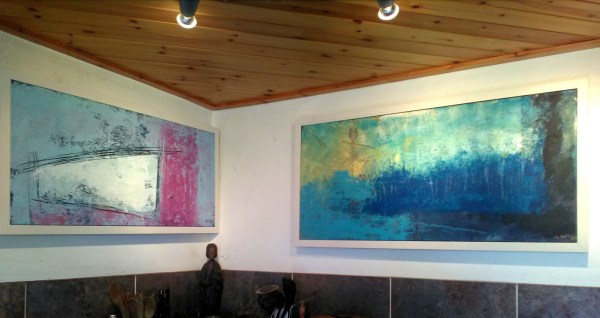

‘Evening walk, Cruit Island’
100 x 155cm
I’m thinking about what will hang where
Which paintings complement each other
Thinking that ‘less is more’ but also how many or how few

‘Donegal’ Pair (now framed), one is 80 x 100, second is 80cm sq
Should they go in the same room
What’s the lighting like

‘Ruined Gables, Night Painting’
98 x 150cm

And what about the Ceide Fields pieces? (100 x 80 and 80cm sq). And there’s another of these there already

And there should be some smaller ones too (‘Its Orange Outside’, pair, framed now, 50cm sq)
But of course its not up to me anyway!
On tenterhooks waiting for a studio visit from the curator
Solo show at Green Fuse Gallery, Westport, County Mayo. 29th April to 10th June
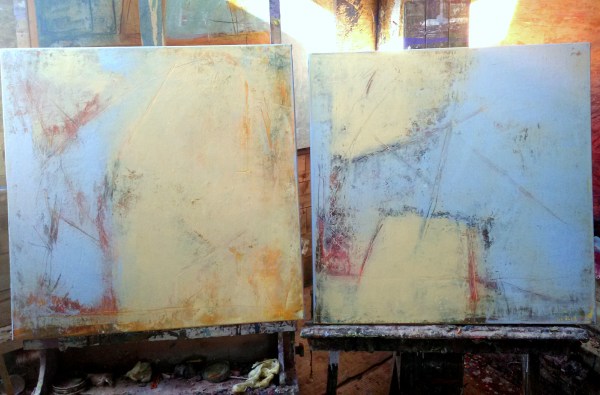

These 2 are each 60cm square and have undergone a change of heart, or a facelift or a renaissance! Formerly they were darker and mostly orange and quite ‘loud’ with a title to reflect that mood : ‘Tolerate chaos’- the title taken from the 10 well known painting rules of the Bay artist, Richard Diebenkorn.
Now they are calmer and paler, with a new title, ‘Formerly chaos’, perhaps with a nod to us being in control of our moods along with our palette if we so choose!

These 2 are a bit bigger, at 80cm square. They have had a similar transformation using a pale palette of pale ochres, yellows and some very pale blue. Their former title was ‘Oceans, a tipping point’ – part of a series of 5 canvases. They haven’t got new individual names yet

Thus one is ‘Musing’, also 80cm square plus frame, painted 2 years ago on my furst residency at Stiwdio Maelor in Corris in Wales and then exhibited at a group show at Terre Verte Gallery in Cornwall. Home now from her adventures

These 2, ‘Sunshine 1&2’ have also just returned from Cornwall and are also each 80cm square plus frame
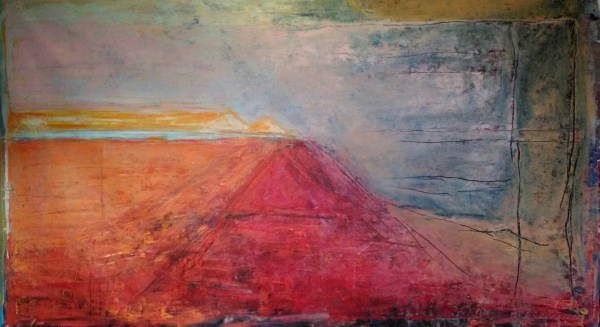

This enormous painting continues to challenge me
It is 150cm x 240cm on primed canvas currently stapled to the wooden wall of my studio
The main debate with myself is about the horizon line. I am gradually settling to a decision to keep the horizon visible only on the left. On the right the orientation of the landscape becomes ambiguous.
Today I added a pink layer over the darker tones on the top right section and also some ochre areas. And then applied solvent and made some deep marks with a palette knife to reveal the dark blue underneath


A small work on paper, glazed and framed

A warm, large, (80cm sq)autumn inspired piece on cradled birch panel

An even larger, (100 cm sq), framed piece on canvas, ‘Rock in the Sea’

Wintery, but warm, framed 80cm sq piece on canvas

A bold, framed, pink, red and blue abstract on board, ‘ Deeper yet and darker still’60cm sq

‘Skylight’, 90cm sq, framed oil on board
I got up quite late but I was unusually fired up once I got going. Maybe it was coffee, or perhaps a sugar hit from all the Christmas chocolate
Things started off fairly sedately with lots of greys and blues and muted tones on the huge new canvas

After working for about 2 hours I went inside for a break. The range had got lovely and hot and the spud I’d put in was crispy and delicious. Got cleaned up and thought that was it for the day. Then had more coffee and chocolate and decided to go back out for a bit
Worked on the big piece some more. Then all of a sudden decided to go all out in red and pink on the 2 canvases that had been on the wall earlier, AND the little muted ones on the opposite wall AND several others


A stonechat is a small bird with a black head that makes the sound of 2 stones knocked together. They flit about madly from the top of furze (gorse) bushes, which are yellow and spike. My surge of energy felt a bit like a transmutation (?) – like in the old tales when a person is magically changed from person to hare to bird
The header image is the railing in the bedroom – perhaps the initial spark for all the stripes – who knows where it all comes from!


I was priming a large piece of coarse jute canvas today with gesso. A long piece 3m x 120cm, rolled out on the mucky floor of the studio.
I took photos as I worked as usual. Of the process and the light and shadows. Of me working. Of the canvas up on the wall. Of the fire.Pondering all the while on what I’ll actually paint once it’s ready


Messed with the photos on Instagram later. Cropped. Negative. Brighten. Contrast. The wee pebble embedded in the rough cement render. In blue. In yellow. The fire. The different rectangles. In triplicate.


The studio is always a painting. In a painting. Of a painting. During a painting.

Painted end of 2015
Sold early 2016 and paid for my trip to San Francisco and New York!

Working on my ‘Rock in the sea’ paintings in February

Some huge pieces on unstretched jute in March


‘Tis calm indeed’ and ‘Moon rising’ from my Spring residency at Stiwdio Maelor in Corris, Wales

The huge, rather surreal piece on unstretched jute ‘Clouds’ from May


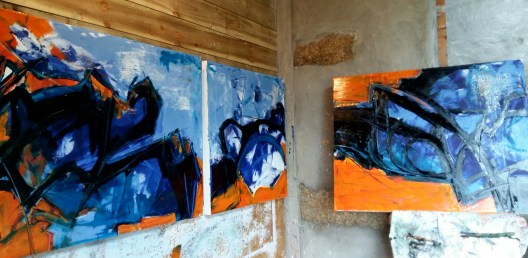
The 5 piece orange and blue and black canvases – can’t remember their titles! June


The two big (120cm sq) pieces, ‘Stateside’ made in anticipation of my big US trip in June


Small works on paper (these 2 are ‘Berkeley’ & ‘5th Avenue’) made on the go during my fantastic, life changing USA adventure in June and July


Some of the big bold pieces I made in July as soon as I got back from New York


‘The path’ & ‘Convergence’
August works in the back kitchen in Wales


‘The dance’ & ‘Columba’ also from August in Wales


Works from my second residency in Stiwdio Maelor in Corris, Wales in September


November


December!
Looking forward to 2017
I have been playing with these ideas and tones, this extract is from Wikipedia:
Shibui (渋い) (adjective), shibumi (渋み) (noun), or shibusa (渋さ) (noun) are Japanese words which refer to a particular aesthetic of simple, subtle, and unobtrusive beauty.
The colors of shibusa are “muddy” colors. For example, in interior decorating and painting, gray is added to primary colors to create a silvery effect that ties the different colors together into a coordinated scheme. Depending upon how much gray is added, shibui colors range from pastels to dark. Occasionally, a patch of brighter color is added as a highlight.
The seven elements of shibusa are simplicity, implicity, modesty, silence, naturalness, everydayness, and imperfection.
https://en.m.wikipedia.org/wiki/Shibui


These seem to fit with the Blood and Concrete paintings from a week or so ago

Maybe it’s a series
 donegallizdoyle